
Finding the sweet spot between radical minimalism and essential safety is the ultimate art of ultracycling riding audax events. It’s a constant optimization. Every gram saved makes the climbs faster, but every piece of gear left behind increases the risk when the elements turn against you. In the high mountains, weight isn’t just a preference—it’s a strategy for success and saving energy.
My current setup is the result of years spent in the saddle, shaped by countless nights on the road and the lessons learned from previous ultra-endurance events. It has been an iterative process of testing, failing, and refining. For my upcoming season, I’ve distilled this experience to its absolute core. The goal is simple – riding ultralight. Because when you’re facing thousands of meters of vertical gain, weight becomes your primary opponent. However, being light doesn’t mean being unprepared. You need to be 100% self-sufficient when cold and rain hits on a remote high pass at 2:00 AM.
This philosophy will be put to the ultimate test again this June at the Alpi 4000. Crossing the Italian Alps and the Dolomites, this Grand Brevet covers 1,300 kilometers and more than 20,000 meters of climbing. It is one of the toughest challenges in the world of self-supported and Brevet cycling, demanding not just physical grit, but a perfectly dialed kit that leaves no room for ‘maybe’ or ‘just in case’ items.
A quick note: This article is only about what’s in my bags. Clothing and bike choice are very personal, so I’ll leave those to you.
Ultralight Brevet Setup
In ultra-cycling and bikepacking, traveling light is the key for me. For the Alpi 4000, I’ve chosen a setup that skips unnecessary luxury but keeps everything safe. Every item has a reason to be there, and every gram counts. I fit everything into just two bags: a frame bag and a saddle bag.
Long-Distance-Cycling Hygiene Tips
Staying healthy is often underrated on long rides. When you’re exhausted, it’s easy to get sick or develop saddle sores. That’s why I always pack wet wipes, a toothbrush, toothpaste, and a change of clothes. After hours on the bike, fresh breath and clean socks aren’t a luxury—they keep your spirits high. If my bib shorts get too dirty, I’ll just wash them in a lake. It’s June, so a quick jump into cold water is a great way to refresh anyway. I hope so 🙂
Emergency Repair Kit for Audax Cycling
Spare tubes are standard, but my kit is like insurance for when things really go wrong:
Spare Tire: A tube is useless if your tire has a big cut. That’s why I always carry a spare tire.
Lights: My Lupine light system with two large batteries is my top priority. A broken light during a night descent in the mountains is dangerous, so I always bring backup lights.
Electronics: I’m taking my Di2 charger. Usually, I don’t need it, it‘s peace of mind.
Essential Tools – not only for the Long Distance
On long rides, you need tools you can trust—and more importantly, tools you know how to use. Never head out for a Grand Brevet without a dress rehearsal. I’ve tested every single item in my kit to be sure not only that it works, but that I can operate it when I’m exhausted on a mountain pass. My rule is simple – if you can’t fix it on the roadside, don’t bring it. I always carry a small, waterproof bag with these essential items:
A multi-tool with a chain breaker, tire levers with electrical tape, spare bolts, TPU patches, valve extensions, and a valve adapter for gas stations. I also pack a chain lock, a piece of cord to open the chain lock, and some bandages.
I never go for a ride without a pump and an extra TPU tube. There is also one special item in my bag: a pencil. In 2014, I was at a checkpoint on the Polish border at night and my pen didn’t work. Since then, the pencil goes everywhere with me. It might seem pointless or old-fashioned, but it’s always good to have something to write with. To be honest, it’s more of a personal quirk of mine.
Your Ride, Your Rules
Keep in mind: This list is just a advice and shows how I like to ride. Every Cyclist is different, and everyone has their own needs for comfort and safety.
I’m not here to tell you exactly what to do. I’m just sharing my setup to help you out, based on years of riding and making my own mistakes. Audax and Brevet riding is all about trial and error. You’ll either know this already or find out soon enough! In the end, you need to feel safe and happy with your gear when you’re alone on a mountain pass at midnight.
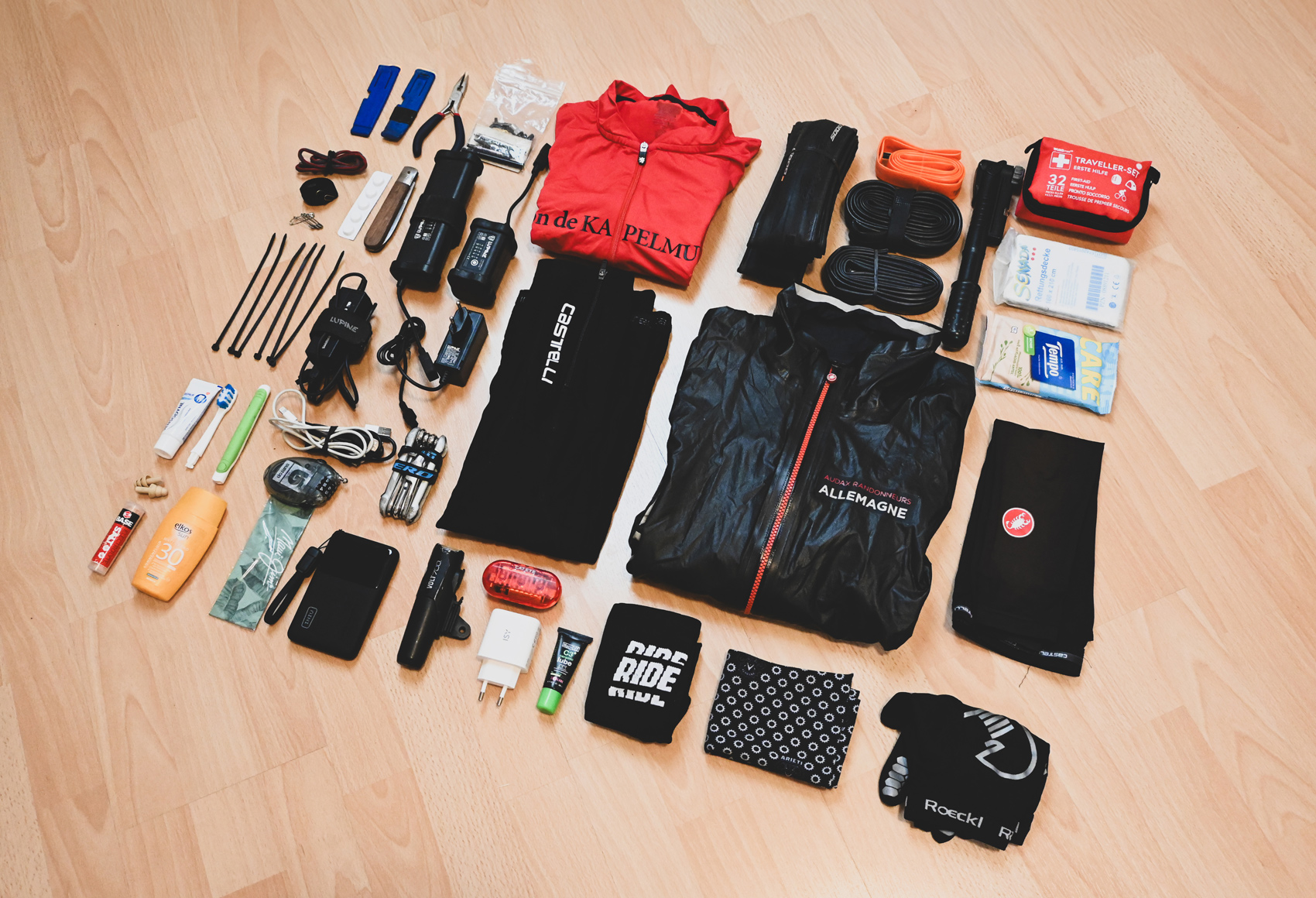
Audax Kit for a 1,300 km Adventure
Preparing for a 1,300-kilometer ride across the Alps requires a delicate balance between weight and self-sufficiency. Here is my detailed bikepacking list for the Alpi 4000 this June.
Tech & Lighting
- 2 x Power Bank (10,000 mAh, 45W): High-speed charging is important during short stops.
- 2 x Lupine Battery Pack: 10,000 mAh + 7,600 mAh.
- Lupine Charger: Light is your most important safety asset.
- Backup Lighting: Replacement front and rear lights.
- Di2 Charger: To avoid singlespeed in the mountains 🙂
- 65W USB Wall Plug: When a socket is available, I need to charge as fast as possible.
- Cables: All necessary accessory cables.
Maintenance & Repairs
- Tires & Tubes: 1 spare tire, 3 inner tubes, and 2 tire levers.
- Pump: A classic manual pump. Electric is comfortable, but manual never runs out of battery.
- Multi-Tool: Must include a chain riveter.
- Hardware: A sharp pocket knife and mini pliers for heavy-duty repairs or stubborn parts.
- Drivetrain: Chain oil, master link, and a spare derailleur hanger.
- The Small Stuff: 6 cable ties, valve extensions, a valve adapter (for gas station pumps), and spare valve cores.
- Emergency Kit: TPU patches and a piece of cord (versatile for repairs or even opening a chain link).
Personal Care & First Aid
- Hygiene: Toothbrush, toothpaste, and wet wipes.
- On the Road: Sun protection, lens cleaning cloth.
- Nutrition & Recovery: Salt, minerals, and caffeine tablets for those long night shifts.
- Medical: Band-Aids, a compact first-aid kit, and a rescue blanket for emergency thermal protection.
Clothing & Comfort
- Layering: Arm warmers, leg warmers, and a Buff (neck warmer).
- Weather Protection: Shakedry rain jacket and lightweight rain gloves.
- Earplugs: No one can sleep when you’re lying next to someone who snores.
- The “Freshness” Factor: One jersey and a fresh pair of socks. After 48 hours on the road, a dry change of clothes is the ultimate morale booster.
Bike & Body
- Cockpit & Light: Lupine SL AF (front), Topeak Redlite (rear), Wahoo bike computer.
- Apparel: Bib shorts, baselayer, jersey, safety vest, socks, shoes, helmet, and sunglasses.
- Storage: Frame bag, Saddlebag, 2 water bottles.
Final thoughts
Of course, no equipment list can prepare you for a 2,000-meter mountain climb at 3 a.m. Equipment is only a part of riding this Brevet. Everything else depends on your legs, your endurance, and your mental strength. But with the perfect equipment, you can stop worrying and focus entirely on the wonder and beauty of cycling in the mountains. The Alpi 4000 is waiting now.
Do you have any tips of your own, or did I miss something essential? I’d love to hear from you! Feel free to reach out at bernd@audax-franconia.de

Mind behind Audax Franconia. Graphic Designer and endurance cyclist. Chasing miles in Franconia or exploring the world. Heart for Italy. Fascinated by Asia. Sharing stories from traveling. Discusses the culture of randonneuring, brevets, and ultra-cycling.